Most small businesses do not lose customers because their product is wrong or their price is too high. They lose them because nobody answered in time.
It sounds small. It is not. Research into inbound call handling puts the average small-business call answer rate at just 37.8%, meaning roughly 62% of calls to small businesses go unanswered; split between voicemail and calls that simply ring out. And once a call is missed, most callers do not wait around: an estimated 85% of callers who reach voicemail never call back, and the majority contact a competitor instead. Add it up across a year and missed calls are estimated to cost the average small business around $126,000 in lost revenue.
The same pattern shows up in digital inquiries. The classic MIT/InsideSales.com lead-response study found businesses are 100 times more likely to reach a web lead, and 21 times more likely to qualify it, when they respond within five minutes rather than thirty. Yet the audited average lead response time across businesses sits at roughly 42–47 hours, according to research cited by both Harvard Business Review and industry lead-response studies. Speed isn't a nice-to-have. It's the deciding factor in whether an inquiry becomes a customer or becomes someone else's customer.
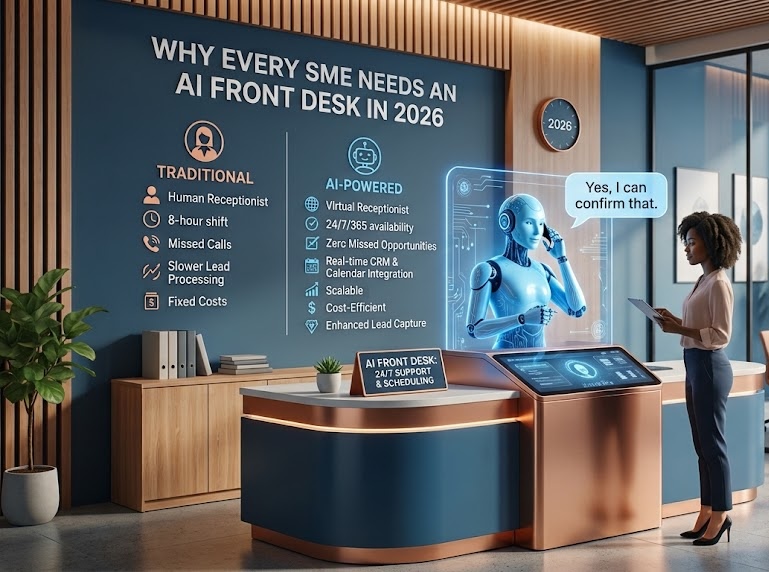
This is the problem an AI front desk is built to solve.
What "no one available to reply" actually costs
It helps to walk through what really happens after a missed enquiry, because the damage compounds in ways that aren't obvious from a single missed call or unanswered message.
The lead goes cold fast. Conversion odds don't decline gently over hours; they collapse within minutes. A gap of even 30 minutes instead of 5 can mean the difference between winning a customer and never hearing from them again.
Most people won't leave a message, and most won't follow up. Voicemail is not the safety net small business owners think it is — the large majority of callers who reach it simply hang up rather than leave a message. The lead isn't "in the queue." It's gone.
One bad experience colors the whole relationship. According to Zendesk research, roughly a third of customers will leave a brand after just one negative experience, and that number climbs sharply after two or three. An unanswered call or unread message counts as exactly that kind of experience, even if the business is otherwise excellent.
It's not just the one customer. Every lost customer typically represents lost referrals too; friends, family, and colleagues who never hear a recommendation because the first interaction never happened.
Customers have already moved to messaging. This is the part many small businesses miss. Global research from WhatsApp's State of Business Messaging report, surveying over 11,000 consumers across 22 markets, found that 73.3% of consumers now prefer messaging when contacting a business over a phone call or email. A business that only answers the phone, and only during office hours, is invisible to most of its own potential customers for most of the day. Put together, this is not a staffing problem you can solve by hiring one more person to sit by the phone. It's a coverage problem, and coverage is exactly what automation is good at.
What an AI front desk actually is
An AI front desk isn't a single chatbot bolted onto a website. It's a small, coordinated system that makes sure every channel a customer might use is covered, all the time, with consistent answers.
That typically means four pieces working together:
- A website chatbot that answers common questions, qualifies visitors, and books appointments the moment someone lands on the site — day or night.
- A WhatsApp click-to-chat line, meeting customers on the channel 39% of consumers now prefer for customer support and where message open rates average around 97–98%, far higher than email.
- A Telegram channel, useful for businesses whose audience, community groups, tech-savvy customers, or international clients; leans toward Telegram over WhatsApp.
- A voice agent that actually answers the phone, handling routine questions, taking bookings, and capturing details for callback when a human is genuinely needed, instead of routing everyone to voicemail.
The key design choice is that these channels aren't four separate silos each with their own logic and their own gaps. They're connected into one system, drawing from the same knowledge base and the same booking calendar, so a customer gets a consistent, accurate answer whether they call, text, or type into a chat window. Nobody has to repeat themselves, and nothing falls through the cracks because it landed on the "wrong" channel.
Why the multi-channel piece matters as much as the AI piece
It's tempting to think the value here is just "a chatbot that talks like a human." That's part of it, but it's not the main event. The main event is coverage plus consistency.
Coverage means an enquiry that arrives at 9 p.m. on a Sunday gets a real, useful response instead of sitting until Monday morning; closing the gap where nearly two-thirds of consumers say they expect to reach a business outside standard 9-to-5 hours.
Consistency means the business doesn't quietly train its best customers to avoid it. If the WhatsApp line gets fast, accurate replies but the phone rings out, customers learn to only use WhatsApp - and the business loses the trust of everyone who still prefers to call. When every channel is backed by the same system, that inconsistency disappears. Whether someone found the business on Google and called, or found it on Instagram and messaged, the experience feels equally competent.
There's also a compounding effect on staff time. Front desk and admin staff at small businesses spend a large share of their day answering the same handful of questions: hours, pricing, availability, "do you deliver to my area," "can I reschedule." An AI front desk absorbs that repetitive volume automatically, which means when a human does step in, it's for the calls and conversations that actually need a person: complex requests, complaints, or high-value sales conversations where judgment matters.
What this looks like in practice
Picture a small home-services business: a plumber, an electrician, a clinic, a salon. A potential customer finds them on Google late at night, calls, and the call goes unanswered because the office is closed. Under the old model, that's a missed call, a voicemail nobody checks until morning, and — statistically — a customer who has already called someone else by the time anyone gets back to them.
With an AI front desk in place, the same call is picked up immediately by a voice agent that can answer basic questions, check general availability, and either book a slot or take enough detail for a fast morning callback. If the same customer had instead messaged on WhatsApp, they'd get the identical information from the identical knowledge base, no waiting required. Either way, the enquiry is captured, qualified, and — where possible — converted, instead of vanishing.
This is the shift that matters: from "we'll get back to you" to "you're taken care of right now."
Getting started without overhauling everything
Small businesses don't need to rebuild their operations to adopt this. The practical path is usually incremental:
- Start with the channel losing the most business. For service businesses that live on inbound calls, that's usually the phone. For businesses whose customers already message on WhatsApp or Telegram, start there instead.
- Feed the system real, current information — services, pricing, hours, policies — so answers are accurate rather than generic.
- Set clear handoff rules for when a human needs to step in, so complex or sensitive conversations aren't left to automation.
- Connect the channels so the chatbot, WhatsApp line, Telegram channel, and voice agent all pull from the same source of truth, rather than operating as separate, inconsistent tools.
- Review and refine based on the questions customers actually ask, which usually surface gaps in the initial setup within the first few weeks.
The bottom line
The businesses losing enquiries today aren't usually losing them on quality, price, or reputation. They're losing them in the gap between "customer reaches out" and "someone responds" — a gap that, on average, is measured in hours when it needs to be measured in seconds. An AI front desk closes that gap across every channel a customer might use, so the business stops competing on who happens to be near the phone and starts competing on the strength of what it actually offers.
At Firm Technologies, we build these systems — website chatbot, WhatsApp, Telegram, and voice agent — as one connected front desk rather than four disconnected tools, so every enquiry gets a fast, accurate, consistent answer, and your team is freed to focus on the conversations that truly need a human touch.
Sources: Sawy Missed Call Statistics; Dialzara, The Cost of a Missed Call; Aira, 62% of Business Calls Go Unanswered; TheContentLabs.AI, Missed Call Statistics 2026; WhatsApp Business, State of Business Messaging; YCloud, WhatsApp Statistics for Businesses; Ainora, Missed Call Statistics for Small Business 2026.